




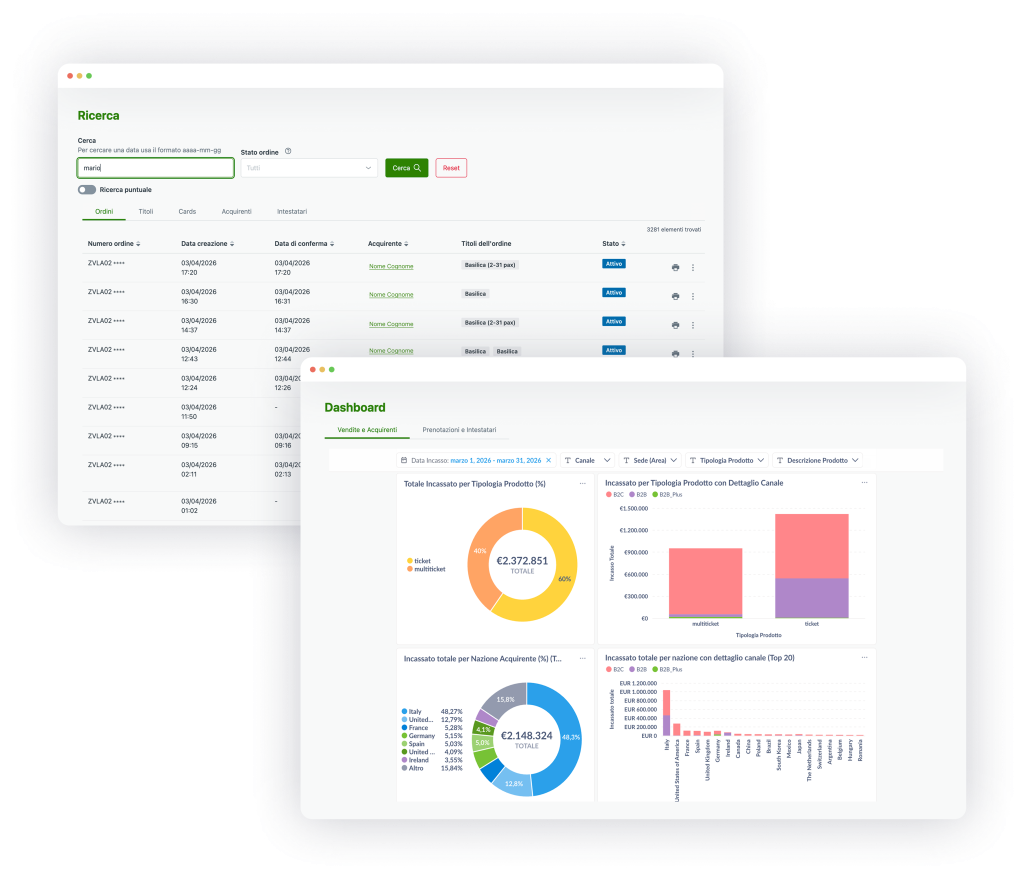



The only Governance Ecosystem for transforming every place into a Smart Destination.

From omnichannel sales to hands-free validation, we integrate every touchpoint into a single wallet for your customers. We optimise operations with simplicity, ensuring scalability and increased revenue for all your services.

Discover Domnia dPass

Comprehensive visitor management, designed for a seamless experience from start to finish.

Discover Domnia dPass

A solution suitable for every service sector.

Native integrations with the technology ecosystem

Engage with your world, from day one. Whether for payments or access, Domnia is ready to connect with the leading industry players. Expand your capabilities by leveraging the ecosystem you already know, with the utmost ease of integration.

Discover Domnia dPass

Stories of organisations that have transformed their hospitality management.

Milan Civic Museums

Domina digitises Milan's entire museum network in 19 days: online and on-site ticketing, 10 physical tills and access control for over 350,000 entries with no operational interruptions.

Livigno Smart Destination

APT Livigno unifies tourists, residents, and seasonal workers in a single Smart Card with Domnia: territorial welfare, distributed logistics in hotels, and real-time RFID access control.
Why do leading organisations choose dPass

Five pillars that make dPass the only “Enterprise-Grade” management system.

1. Atomic Architecture and Infinite Composability

Unlike rigid systems, dPass reasons with simple products. This allows the creation of a fluid commercial offering: from single entries to Composable Bundles (Pick-and-Choose). The advantage? You can offer the visitor maximum freedom of choice without losing control over inventory and pricing configuration.

2. Partner-Ready Financial Reconciliation"

The real differentiator is in the back-office. dPass doesn't just record the payment, but manages revenue recognition. By distinguishing between Sales Date and Usage Date, the system automatically calculates how much is due to each partner (Museum, Guide, Transport), fundamentally resolving the issue of complex cash flows and multi-service bundles.

3. Combined products, Cards and Residual Margin

In an ecosystem of bundles and cards, not everything sold is consumed. dPass is designed to identify unredeemed titles, allowing administration to correctly retain residual margins instead of distributing them in vain. It is pure financial efficiency that translates into net profit.

4. Uncompromising White-Label

While competitors use your visibility to promote their own platform, dPass disappears. The customer's brand dominates every touchpoint, from the sales portal to the fiscal receipt, ensuring a consistent user experience and high-level institutional positioning.

5. Integrated Multi-Entity Ecosystem

dPass was created to manage complexity: different cost centres, different partners and different channels (Web, Desk, B2B). It is a single hub that speaks different languages, unifying reporting for administration and simplifying access for visitors, regardless of the variety of services included (Museums, Car Parks, Retail).

Domande Frequenti

In what ways does dPass differ from common ticketing systems (like Eventbrite)?
dPass isn't just a transactional tool. It's an Enterprise-Grade ecosystem designed for the management of complex sites. While generic systems handle individual sales, dPass manages the entire visitor lifecycle, reporting to multiple partners and integration with physical hardware (turnstiles and readers).
How are multi-service Bundles and Cards managed?
dPass uses an "atomic" architecture. You can create simple products (e.g. Museum entry) and aggregate them into fixed or configurable (pick-and-choose) bundles. The system tracks each individual "sub-product", allowing you to know in real-time which services have been sold and which have actually been consumed.
Is it possible to integrate physical access with turnstiles or scanners?
Certainly. dPass is natively integrated with the main hardware standards (QR, NFC, Barcode) and protocols (such as SkiData or custom solutions). Validation at the turnstile does not only serve for access, but is the trigger that initiates the maturation of credit towards the service provider.
How is the revenue split between the various partners (e.g., Museum + Car Park)?
This is the heart of dPass. The system separates cash responsibility (total takings at the point of sale) from economic responsibility (the accrued cost for each partner). Through detailed reports, you will know exactly how much to pay each supplier based on sales or actual usage (Validation).
What happens if a user buys a bundle but doesn't use all the services?
dPass manages residual margins (No-Shows). At the end of the ticket's validity, the system identifies unused services, allowing your administration to close the accounting entry by retaining the residual value, without generating debts towards partners for services never rendered.
Does the system also manage B2B sales or sales via agencies?
Yes. dPass provides dedicated portals for resellers and partners. You can assign specific price lists, manage prepaid vouchers, or deferred billing accounts, all while maintaining centralised and atomic reporting.
Is it a white-label solution?
At 100%. dPass disappears behind your brand. UX, UI, domains and email communications are completely customisable to ensure the visitor perceives only your institution's identity.
Is dPass scalable for massive visitor flows?
The infrastructure is designed to handle millions of transactions. It is already in use in contexts with very high traffic (such as large basilicas and museum complexes), ensuring stability in both the web portal and the on-site validation systems.
Does it integrate with business CRMs?
Yes, via robust APIs. We can connect dPass data with HubSpot, Salesforce or proprietary systems to power marketing and loyalty strategies based on real purchasing and visiting behaviour.

Ready to revolutionise visitor management?

Let's set up Domnia dPass for your scenario. Optimise workflows, generate extra revenue, collect valuable data.